
Maggie Moor author of psychological crime noir Skinless (Book 1) Charmay: New York Noir Series and Songs. Skinless — Specs

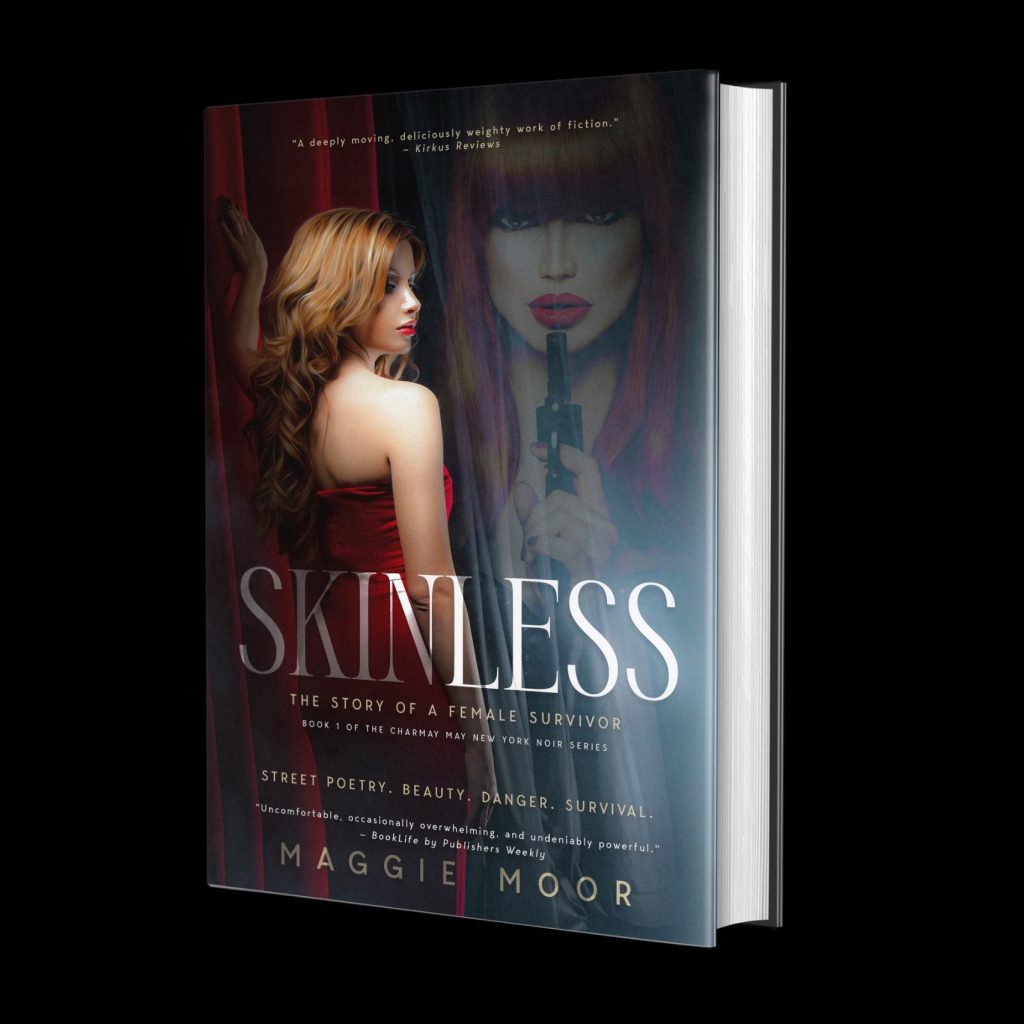
Skinless: The Story of a Female Survivor

Maggie Moor

Identity fractures. Survival is an art. Redemption isn’t what you think.

1999 NYC: An orphan-misfit singer hustling for the American Dream masks her “skinless” trauma behind a glittering alter ego—until the mask starts to destroy her in a fever of betrayal, hurling her into a brutal reckoning.

SKINLESS is an expanded x-ray of the things we hide and the art that speaks through us—urgent, unfiltered—and a raw look at how we adapt to survive. 

Voice

Interior, stream-of-consciousness. Street poetry in real time. Honest, raw voice.

For readers who like

Psychological noir, character-driven fiction, and intimate, voice-led narratives.

Details

Series: Charmay: New York Noir

Edition: Second Edition, Expanded and Revised

1999 NYC — Lower East Side

Hardcover / Paperback / eBook

Title: Skinless: The Story of a Female Survivor

Series: Charmay: New York Noir (Book 1)

Edition: Second Edition: Writer’s Edit (Expanded & Revised, November 2025)

Genre: Literary Psychological / Crime Noir Fiction / Psychological Thriller / Urban / City Life Fiction

Setting: 1999–2001 Lower East Side, New York City

SPECS:

Ebook: Oct 22, 2025 | Print: Nov 12, 2025 | pp. 350

ISBN-Hc: 979-8-9931212-3-9 | $27.99US | Trade Pb: 979-8-9931212-2-2 | $18.99US | ePub 979-8-9931212-4-6 | $5.99US |

Pearl of Peace Publishing | Dist. By Ingram | Ordering: Ingram iPage — returnable; 55% trade discount

Multi Media:

  • SERIES: Book 1 of the Charmay: New York Noirseries. Standalone.
  • SECOND EDITION: Writer’s Edit, Expanded & Revised, November 2025.
  • COMPANION ALBUM: Skinless: Songs from the Book. Jazz-noir and downtempo — featuring Kenny Rampton (Wynton Marsalis) and Eddie Ojeda (Twisted Sister).
  • SUBSTACK SERIES: Explore Skinless: Inside the Story. A 9 episode multi-media experience.

Critical Praise:

“A deeply moving, deliciously weighty work of fiction.”KIRKUS REVIEWS

“Moor’s poetic, stream-of-consciousness prose drops readers directly into the mind of a trauma survivor… equally profound is the author’s careful unpacking of a common, problematic archetype in the noir genre. While Charmay might appear to be a typical femme fatale… her gifts for introspection and observation make her the perfect lynchpin for the author’s subversion. She is not the object of an external gaze—she’s a character with agency and authority. Those who surrender to the flow will be rewarded.”

KIRKUS REVIEWS

“A must-read… Moor tells Charmay’s experiences with abuse and betrayal in stark, unsentimental prose.” — INDIEREADER

“Uncomfortable, occasionally overwhelming, and undeniably powerful… a portrait of survival that doesn’t sanitize the mess.” — BOOKLIFE BY PUBLISHERS WEEKLY

“An eloquent crime novel—street poetry renders the city in lush, sensual language and a heroine’s raw will to live.” — Benjamin Welton, FOREWORD REVIEWS

“A humane, unsparing portrait—wringing hope from the drug-drenched, sex-soaked streets of 1990s New York City.” — Danielle Ballantyne, FOREWORD REVIEWS | Interview

SKINLESS is 4.6 stars with over thirty reviews on Goodreads.

From Readers

“This is different and that is good. It tells a story which is worth the hearing but it also offers some amazing characters and a writing style which is somehow modern and vintage at the same time. The style takes you into the mind of the protagonist in a way which conventional, descriptive prose may not. I really liked it.”— Louise Gray, NetGalley reviewer, Goodreads

“Moor’s prose has a lyrical and poetic flow… evocative of beat generation writers like Kerouac, Ginsberg, and Burroughs—with the New York City style grit of Jim Carroll. The word play… is phenomenal.” — David H.K., Goodreads

“Maggie Moor has a voice unlike any I’ve ever encountered. Both hip and illuminating. A voice that lifts the mind to a place it’s never been.” — Kate Lardner, author

 “Crafted in the moment, thinking and reacting in real time… she gives us a real internal voice… a writing exercise that would intimidate an author writing their 10th novel—and Ms. Moor has pulled it off.” — Mark McLaughlin, Amazon reader

 “Quirky, singular… Language so original it vanishes words as we know them… In a word, Skinless is a stunner.” — Stacey Donovan, writer and editor

 “Ms. Moor’s unique writing style takes you directly inside the narrator’s mind and heart… twisting and turning right up to the final, suspenseful ending; the images and life lessons stay with you long after.” — G.D. Barbara Hodge

 “Written in the first person and with a special style that grabs you inside the protagonist’s mind… different and original. I highly recommend it.” — Vincent J. Wallace, author of Deadly Wealth

“Noir-ish feel that hooked me right away… a thrilling and realistic story about living on the edge in 1990s New York City.” — Antwan Floyd Sr., author

Skinless: Works Cited

A curated list of the works cited in dialogue and internal thought on the pages of Skinless — Insight into Char,ay’s vharacter and the literary feel of the book.

Works Cited in the text:
  • Alice in Wonderland, 28
  • “Amazing Grace,” the snow globe Sam gives Charmay places the spiritual, 106
  • “A-Train,” jazz singer at Hudson’s Restaurant, 72
  • Angel Heart, 1987, neo-noir psychological thriller, Charmay likes the film, 21
  • “Angie,” (1973) Stones song, Charmay thinks of it near the end of the book when Sam comes back after the fight, 315
  • Arms and the Man, George Barnard Shaw.  Charmay tells Rex she’s studying in her script analysis class, Rex tells her it was Marlon Brandon’s stage swan song (1953); both of them like the play, 171,172, 173
  • Baby Doll, film, based on Tennessee Williams’s 27 Wagons Full of Cotton, 1956
  • Bach concerto, 83
  • Backstage, where Charmay looks for auditions, 150, 221
  • Barbarella, character, 223
  • Beaudelaire (1821-1867), French poet, 7
  • The Bell Curve: Intelligence and Class Structure in American Life, by political scientist Harvard man Charles Murray, 111
  • Bible, 113
  • Blueprint 3, Jay Z album, 88
  • Body Heat, 326
  • Bonnie and Clyde, 326
  • “Born to Be Wild,” Sam sings his version while cooking, 126
  • Breakfast at Tiffany’s, (1961), 40
  • Bus Stop, 257
  • Business of Acting, 111
  • “But Not for Me,” by George Gershwin, 224, 225
  • Caged Bird, (1969) I Know Why the Caged Bird Sings, Maya Angelou, one of Charmay’s faves, 108
  • Caligula, 1979, 49
  • Canadian Newspaper, where Charmay and Sam’s Las Vegas wedding pictures ended up on the cover, 75
  • Carrie, Charmay’s aborted fetus calls up the Stephen King horror film, 355
  • Cat on a Hot Tin Roof,  Tennessee Williams, 96
  • Caravan of Dreams, Idries Shah, 1968, 272
  • Casablanca, 151
  • Chopin, “Nocturne, op 9, no. 2,” 294
  • Color Purple, (1982), Alice Walker, one of Charmay’s faves, 108
  • “Cry like a Baby,” Roberta Flack, a song Charmay performs for Rex, 84, 227
  • Danger: Diabolik, 1968 film, 89
  • Dead Eye Boy, The, 237
  • Divorce American Style, 253
  • Family Feud, TV game show, 155
  • Fantasia, 127
  • Elementary Gazette, Charmay’ school paper, 49
  • Enquirer, 292
  • Entertainment Weekly, 313
  • Faster, Pussycat! Kill! Kill!, Russ Meyer film, Charmay boasts to Sam’s parents that a director has asked her to study a part from the cult class, 225
  • Fear of Flying, Erica Jong, 325
  • Fool for Love, Sam Shepherd, Charmay played May, 94
  • Fortune, 199
  • “Four Quartets 4: Little Gidding,” T. S. Eliot’s, 265
  • Friendship, Egon Schiele painting Charmay love, 128
  • “Für Elise,” Beethoven’s bagatelle, tune playing on a ballerina music box of Charmay’s childhood, 57, 107
  • Gemstones of the World, a book from Drew’s mom, 176
  • Gift of the Magi, The, O’Henry story, Charmay thinks she should have used this reference instead of The Muse, at Sam’s shrink’s, 203
  • Gilda, namely Rita Hayworth, 257
  • “Girls, Girls, Girls” Motley Crue, 53
  • Giselle, from Lion King 218
  • The Glass Menagerie, Williams, Sam compares Charmay’s daydreaming to Laura in the play, Charmay had play Laura at Stella Adler’s, 96
  • Grinch, character’s name from How the Grinch Stole Christmas, 162, 185, 295
  • Hatful of Rain, Gazzo, Charmay tells Rex she’s playing the lead, 150, 151
  • Home Cooking, name of magazine at Sam’s shrinks’, 199
  • “Honey in My Honeycomb,” Ethel Waters; jazz singer at Hudson’s, 59
  • “Hot Legs,” song Sam sings while cooking, 126
  • How the Grinch Stole Christmas, opening lines of the song from, 295
  • “Hush,” by Maggie Moor, 122, 123, 304
  • Importance of Being Earnest, The, 151
Works Cited in the text:
  • “I Thought About You,” Johnny Mercer; Charmay sings in a movie, 224
  • James Joyce’s The Dead Broadway musical production with Christopher Walken (1999), 269
  • Jetsons, The, 154
  • Kama Sutra, 35
  • Kids, magazine at Sam’s shrink, 199
  • Last Exit to Brooklyn, 21
  • Last Seduction, The, 1994, 292
  • “Lilac Whine,” song by James Shelton, 1950; Charmay tunes into the song when she’s with Rex at Hudson’s, 69
  • Lion King, The, 226
  • Little Lord Fauntleroy by Frances Hodgson Burnett, 8
  • “Love Potion Number Nine,” Searchers, 186
  • Lucia di Lammermoor, Donizetti, 85
  • Magnolia, film of P. T. Anderson (2000), 27
  • Maltese Falcon, Falcon, 327, 331
  • Miss Sadie, Rita Hayworth film, 257
  • Moby Dick, 338
  • Modigliani painting, 28
  • Mozart’s “Allegro” from A Little Night Music, 184
  • Muse, The, 291
  • “My Mother’s Son-in-Law,” 185
  • National Geographic Nautical Photographs, 110
  • New Rose Hotel (1998), 264
  • New Testament, 113
  • New Yorker, The, 236, 237
  • Night before Christmas, 338
  • 91/2 Weeks, film, Charmay tells Sam Rex is obsessed with the film, 118, 263
  • “Numb”, Beth Orton, Portishead, 50
  • Old Testament, 113
  • Oz, 31
  • Paris Nightlife, Picasso painting; Charmay refers to while on stage at Lucky Strike, 245
  • “Pearly Gates, The” Barostti cartoon, 237
  • Pope of Greenwich Village, (1984) 21
  • Porter, Cole; standards, 221
  • Post, The, copy in the pocket of the Lucky Strike owner, 248
  • Pride and Prejudice, 199
  • Rainman, 343
  • Requiem for a Dream, 268
  • River of No Return (1954), 257
  • “Run This Town,” Jay-Z, 88
  • Sacred Dance, 36
  • Sea of Love, 19889, film, 268
  • Sex in the City (1998), 320
  • Short Cuts, 237
  • Simpsons, 163
  • Sleeper, 174
  • Sopranos, second season, 226, 320
  • Spiderman, 263
  • Spoon River Anthology, 69
  • Starry Night, Van Gogh, 1889, 199
  • “Sussudio,” by Phil Collins (1985), 187
  • Taming of the Shrew, 25
  • Times, The, 237
  • True Romance, 1993, pop culture film, Charmay likes, 21, 76, 268
  • Twenty-Four Hours A Day, Hazelden. Daily meditations, 281
  • Water Lilies, Monet, 1914-1926, 199
  • Whatever Happened to Baby Jane?, 117
  • When God Was a Woman, by Merlin Stone, a book Charmay read in Marin, 36
  • “Where is Everybody?” Nine Inch Nails song, 291
  • Where the Wild Things Are, 116
  • Who’s Afraid of Virginia Woolf, Charmay and Sam had played Martha and George in the Albee play at the Adler studio, 89
  • Why Do I Feel Nothing Without a Man, book mom reads, 72
  • Wicked, 240
  • Yellow Pages, Mom uses them, 282, 293
  • “You Can Leave Your Hat On,” Sam sings to Charmay about Rex, 118, 263
  • The Young and the Restless, soap opera, 245

Behind Charmay New York Noir: Maggie Moor

Dark psychological noir from a writer steeped in performance, investigation, and psychoanalysis.

Maggie Moor is a psychoanalyst, author, fitness competitor, and recording artist whose work centers on trauma, addiction, and fractured identity. Her life in music, investigations, and an alternative educational path that blends real‑life immersion with high‑level psychoanalytic training, she brings emotional precision, street‑poetry prose, vivid imagery, layered timelines, and sharp psychological insight to Charmay New York Noir—perspective that could only come from her particular mix of lived experience and academic rigor.

The Series

CHARMAY: NEW YORK NOIR

The hunter is haunted and the blur between performance and self becomes a war for the soul.

A dark psychological crime thriller series rooted in the NYC underground. Across the series, the music, the money, and the memory collide in a visceral descent. As paranoia and control unfold, the lines blur between film and life, witness and perpetrator. It’s not just about the hustle; it’s about the fracture. How people split, dissociate, and fight like hell to come back to themselves.

A BOOK & MUSIC CYCLE

Each standalone novel is paired with a companion album. The arc follows a singer struggling to reclaim her own mind, body, and narrative in the shadows of the city.

Skinless

Psychological Crime Noir with a jazz pulse.

Songs from Skinless

The arc of the story—songs Charmay writes and perform in the pages.

Maggie Moor Skinless Charmay New York Noir